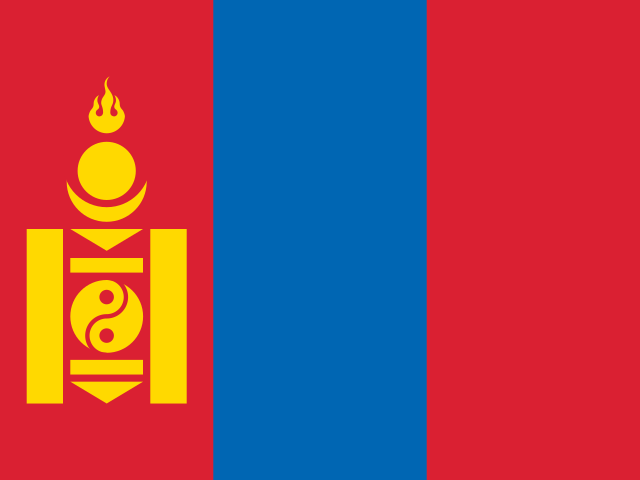
Mongolia overview
Mongolia is a sovereign country in Eastern Asia, in the wider region of Asia. Unlike most entries, its formal name adds nothing to the short one. Government sits in Ulan Bator.
It is home to roughly 3.5 million people, placing it 132nd of 249 by population — between Eritrea above it and Uruguay below. Within Eastern Asia alone it is the 2nd largest of 8 and the 7th most populous.
It covers 1,564,110 km², which ranks it 20th of the 249 countries and territories in this dataset — just behind Iran and just ahead of Peru. For scale, it is a fraction smaller than Iran.
How Mongolia reaches the sea
Mongolia has no coastline of its own, so every ship-borne import and export crosses somebody else's border first. The good news is that the sea is only one frontier away: China and Russia have coastline, which makes them the obvious routes for freight heading to a port.
That geography has practical consequences. Landlocked countries carry higher freight costs than coastal ones because goods change hands, transport mode and jurisdiction more often, and because a neighbour's road, rail or customs problem becomes Mongolia's problem too. It is also why transit agreements with bordering states, and access to their ports, tend to matter more in Mongolia's foreign policy than the distance on a map would suggest.
Coastal countries on the border:
Countries bordering Mongolia
Mongolia shares a land border with 2 countries: China and Russia. Each one has its own guide here.
Mongolia at a glance
- Capital
- Ulan Bator
- Population
- 3,524,788
- Area
- 1,564,110 km²
- Region
- Eastern Asia, Asia
- Languages
- Mongolian
- Currency
- Mongolian tögrög (MNT)
- Calling code
- +976
- Internet TLD
- .mn
- People per km²
- 2
The lie of the land
Its reference point sits at 46.0° north and 105.0° east, which puts it in the northern hemisphere, roughly 5,121 km from the equator, in what geographers would call temperate latitudes.
Countries on the same parallel, far away in longitude, include Kazakhstan, France and Romania.
2 countries share a land border with it: China and Russia. The largest of them by area is Russia, while the most populous is China. Together those neighbours hold about 1.55 billion people.
This is one of the world's landlocked countries. That is true of 45 of the 249 entries here, which reliably raises the cost of trade, because port access depends on a transit agreement with a neighbour. You can see the full picture on the landlocked countries page.
Where Mongolia is on the map
The map below is centred on Mongolia at roughly 46.00°, 105.00°. Pan and zoom to see how it sits against its surroundings — the shape of a country's borders explains a surprising amount about its history.
Map data © OpenStreetMap contributors
How big is Mongolia, really?
Put next to every other entry on this site, Mongolia ranks 20th of 249 by area and 132nd by population. That works out at 1.0% of the combined land area of all 249 entries and 0.043% of their combined population. Those denominators matter: this list includes territories and dependencies as well as UN member states, so a rank here is not the same as a rank among sovereign countries.
For a sense of scale, the entries immediately either side of Mongolia in the size ordering are Iran at 1,648,195 km² and Peru at 1,285,216 km², against Mongolia's 1,564,110 km². If you can already picture one of those, you can picture this one.
Density tells a different story from either raw figure. Mongolia averages 2 people per square kilometre of total area, which makes it among the emptiest places on the list — 240th of the 247 entries that have both a population and a measured area. Total area includes inland water, so the true figure for habitable land is higher than this.
Who lives in Mongolia
Density comes out at around 2.3 people per square kilometre, which makes it very thinly populated. The median across all 249 entries here is about 91 per square kilometre.
The demonym is Mongolian, so residents are Mongolians.
Mongolian is the only official language. No other entry in this dataset lists Mongolian, so on this list it stands alone.
Against Asia as a whole it is the 42nd most populous of 50 entries, and it accounts for under 1% of everyone living in Eastern Asia.
Mongolia within Eastern Asia
Zoom in from the world to Eastern Asia and Mongolia sits 7th of 8 by population and 2nd by area. Its immediate company in that ordering is Hong Kong just above and Macau just below, which is a more honest comparison set than a global league table.
China is the largest of the group by population, and every entry in Eastern Asia has its own page here if you want to work through the whole neighbourhood rather than one country at a time.
Money and language in Mongolia
The Mongolian tögrög (MNT) is used only in Mongolia among the 249 entries on this site. Its own currency is one of the clearest markers of an economy that sets its own monetary policy rather than importing somebody else's.
Mongolian is listed for Mongolia and for no other entry on this site. A language confined to one country is unusual, and it is normally a sign of long isolation or of deliberate revival.
The practical details for Mongolia
It uses the Mongolian tögrög (₮, MNT). That currency appears nowhere else on this list.
Ulan Bator is the seat of government and the answer most quizzes are looking for.
The top-level domain is .mn. Calls from overseas start with +976. In ISO terms it is mn in two letters and MNG in three.
Mongolia is one of the 192 UN member states in this dataset. The other 57 entries are territories, dependencies or observers, which is why totals on this site run to 249 rather than the familiar 195.
Fun facts about Mongolia
- It is landlocked, one of 45 entries here with no coastline of its own.
- People from Mongolia are known as Mongolians.
- Websites based there use the .mn domain.
- Within Eastern Asia it is the 2nd largest of 8.
- It is 132nd of 249 by population, with about 3.5 million residents.
- Kazakhstan and France sit at almost the same latitude, on the far side of the globe.
- It lies about 5,121 km from the equator, in temperate latitudes.
- The Mongolian tögrög is used here and nowhere else on this list.
Mongolia — frequently asked questions
- What is the capital of Mongolia?
- The capital of Mongolia is Ulan Bator.
- How big is Mongolia?
- Mongolia covers 1,564,110 km², ranking 20th of 249 by land area. That makes it a fraction smaller than Iran.
- Which countries border Mongolia?
- Mongolia borders 2 countries: China and Russia. Russia is the largest of them by area.
- What language is spoken in Mongolia?
- The official language of Mongolia is Mongolian. No other entry on this list gives it official status.
- Is Mongolia landlocked?
- Yes. Mongolia has no sea coast, which makes it one of 45 landlocked entries in this dataset. Everything it imports or exports by sea has to cross a neighbour's territory first, and that transit dependency is a well-documented drag on trade costs.
- What currency does Mongolia use?
- Mongolia uses the Mongolian tögrög, written ₮ (currency code MNT). No other entry in this dataset uses it.
- Where is Mongolia located?
- Mongolia is in Eastern Asia, part of Asia. Its reference coordinates are 46.0° north and 105.0° east, roughly 5,121 km from the equator in temperate latitudes.
- Is Mongolia a country?
- Yes. Mongolia is a sovereign state and one of the 192 UN members listed on this site.
- What is the population of Mongolia?
- Mongolia has a population of about 3.5 million, which makes it the 132nd most populous of the 249 countries and territories listed on this site. Eritrea sits just above it and Uruguay just below.