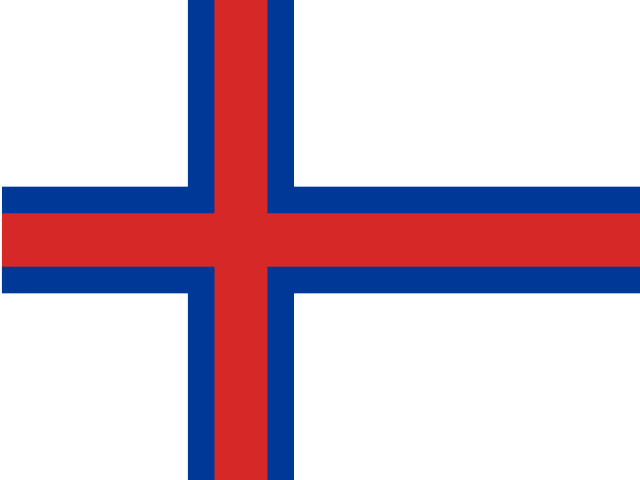
Faroe Islands overview
The Faroe Islands is one of the territories of Northern Europe that appears on world lists without being a UN member state. Unlike most entries, its formal name adds nothing to the short one. Government sits in Tórshavn.
It is home to roughly 54,681 people, placing it 209th of 249 by population — between Greenland above it and Saint Kitts and Nevis below. Measured only against its own subregion, it is 13th of 16 in size and 14th in population.
It covers 1,393 km², which ranks it 186th of the 249 countries and territories in this dataset — just behind the Åland Islands and just ahead of Martinique. For scale, it is roughly half the size of Luxembourg.
The status of Faroe Islands
Faroe Islands does not hold a United Nations seat of its own. It is administered as a dependency or overseas territory rather than as a sovereign state, which is why it sits outside the 192 member states while still appearing among the 249 entries on this site.
Not holding a UN seat is not the same as having no self-government, and the administrative details make that clear. Faroe Islands has 5 of the five markers of separate administration tracked on this page — its own currency, its own dialling code, its own internet domain, its own iso codes and a designated capital. In day-to-day terms it is run substantially as its own jurisdiction.
- Its own currencyDKK, FOK
- Its own dialling code+298
- Its own internet domain.fo
- Its own ISO codesfo / FRO
- A designated capitalTórshavn
Faroe Islands at a glance
- Capital
- Tórshavn
- Population
- 54,681
- Area
- 1,393 km²
- Region
- Northern Europe, Europe
- Languages
- Danish, Faroese
- Currency
- Danish krone (DKK), Faroese króna (FOK)
- Calling code
- +298
- Internet TLD
- .fo
- People per km²
- 39
Geography and neighbours of the Faroe Islands
The coordinates the dataset gives are 62.0° N, 7.0° W, which puts it in the northern hemisphere, roughly 6,902 km from the equator, in what geographers would call high-latitude latitudes.
Russia and Canada sit at almost exactly the same latitude on other parts of the globe.
There is no land frontier at all — every boundary it has is a coastline. That puts it among the 85 entries of 249 here with no land neighbours, which shapes how it trades and who it deals with.
Where Faroe Islands is on the map
The map below is centred on Faroe Islands at roughly 62.00°, -7.00°. Pan and zoom to see how it sits against its surroundings — the shape of a country's borders explains a surprising amount about its history.
Map data © OpenStreetMap contributors
What lies nearest to Faroe Islands
Faroe Islands has no land border with any country, which changes what "nearby" means. Measured centre to centre in a straight line, the closest other entry on this site is Iceland, roughly 640 km away. These are approximate distances between representative points, not the shortest crossing between two shorelines, so treat them as a sense of scale rather than a sailing chart.
No land border also means no land crossing: everything and everyone arrives by sea or by air. That single fact drives a lot of what follows on this page, from how goods reach the shops to why Faroe Islands's dialling code and internet domain are worth knowing before you travel.
| Nearest entry | Region | Approx. distance |
|---|---|---|
| Iceland | Europe | 640 km |
| Isle of Man | Europe | 870 km |
| Norway | Europe | 880 km |
| United Kingdom | Europe | 940 km |
| Ireland | Europe | 1,000 km |
Who lives in the Faroe Islands
Spread across 1,393 km², that works out at about 39 people per square kilometre, which makes it less crowded than the typical entry on this list. For comparison, the median entry on this list sits near 91 per square kilometre.
People from the Faroe Islands are called Faroese.
2 languages carry official status: Danish and Faroese. Faroese is listed for no other entry in this dataset, which makes it effectively unique to the Faroe Islands. Danish, the first listed, is shared with 1 other entry worldwide.
Against Europe as a whole it is the 46th most populous of 53 entries, and it accounts for under 1% of everyone living in Northern Europe.
Money and language in Faroe Islands
Faroe Islands does not have the Danish krone to itself. It is one of 3 entries on this site that use the currency, whose code is DKK, and the others include listed below. A shared currency usually points at something real — a monetary union, a currency board, a former colonial administration, or a small economy pegging itself to a large neighbour's money — and it means a price quoted in DKK travels further than you might expect.
Language reaches wider still. Danish is listed for 2 entries here, Faroe Islands among them, so a visitor who speaks it can be understood across a large part of the map. Shared language tends to outlive the empires, trade routes and migrations that spread it, which is why the linguistic map and the political one rarely line up.
Also lists Danish among its languages:
Faroe Islands within Northern Europe
Zoom in from the world to Northern Europe and Faroe Islands sits 14th of 16 by population and 13th by area. Its immediate company in that ordering is Guernsey just above and Åland Islands just below, which is a more honest comparison set than a global league table.
United Kingdom is the largest of the group by population, and every entry in Northern Europe has its own page here if you want to work through the whole neighbourhood rather than one country at a time.
Money, codes and practical details
More than one currency circulates: Danish krone (DKK) and Faroese króna (FOK). It shares that currency with Denmark and Greenland.
If a quiz asks for the capital of the Faroe Islands, the answer is Tórshavn.
The top-level domain is .fo. Calls from overseas start with +298. Its ISO codes are fo and FRO, which is what most databases and flag files use.
On the UN list it does not appear as a member. The dataset does not record which state administers it, so this page does not guess. Of the 249 entries here, 57 are territories or observers rather than member states.
Faroe Islands codes and abbreviations
Every country carries a small set of codes that quietly run the practical world — phone networks, web addresses, passports, luggage tags and dropdown menus. Here are Faroe Islands's, and what each one is actually for.
- Calling code+298
- Dial +298 after your international access code to reach a number in Faroe Islands.
- Internet domain.fo
- .fo is the country-code top-level domain, so a web address ending in it is registered to Faroe Islands.
- ISO two-letter codefo
- Used on vehicle plates, in currency pairs and in almost every dropdown list of countries.
- ISO three-letter codeFRO
- The form you will see on passports, at airports and in sports scoreboards.
- DemonymFaroese
- The correct word for a person from Faroe Islands, and for the adjective form.
Fun facts about Faroe Islands
- Population density works out at roughly 39 people per square kilometre.
- Danish is official here and in 1 other entry worldwide.
- Its capital city is Tórshavn.
- In land area it is roughly half the size of Luxembourg.
- It lies about 6,902 km from the equator, in high-latitude latitudes.
- Ranked by land area, the Faroe Islands is 186th out of the 249 countries and territories on this site.
- It has no land border with any other country — one of 85 such entries in this dataset.
Faroe Islands — frequently asked questions
- What is the capital of the Faroe Islands?
- The capital of the Faroe Islands is Tórshavn.
- What language is spoken in the Faroe Islands?
- The Faroe Islands lists 2 official languages: Danish and Faroese. Faroese does not appear as an official language anywhere else in this dataset.
- What is the population of the Faroe Islands?
- The Faroe Islands has a population of about 54,681, which makes it the 209th most populous of the 249 countries and territories listed on this site. Greenland sits just above it and Saint Kitts and Nevis just below.
- How big is the Faroe Islands?
- The Faroe Islands covers 1,393 km², ranking 186th of 249 by land area. That makes it roughly half the size of Luxembourg.
- Is the Faroe Islands a country?
- Not in the political sense. The Faroe Islands is a dependent territory rather than a sovereign state, and it is not a UN member. It appears on this site because it has its own flag, codes and statistics, but it does not have a seat at the United Nations.
- Where is the Faroe Islands located?
- The Faroe Islands is in Northern Europe, part of Europe. Its reference coordinates are 62.0° north and 7.0° west, roughly 6,902 km from the equator in high-latitude latitudes.
- What currency does the Faroe Islands use?
- The Faroe Islands uses the Danish krone, written kr (currency code DKK). It is shared with 2 other entries: Denmark and Greenland.
- Does the Faroe Islands border any other country?
- No. The Faroe Islands has no land border with any other country, so every route in or out is by sea or air. 85 of the 249 entries on this site are in the same position.