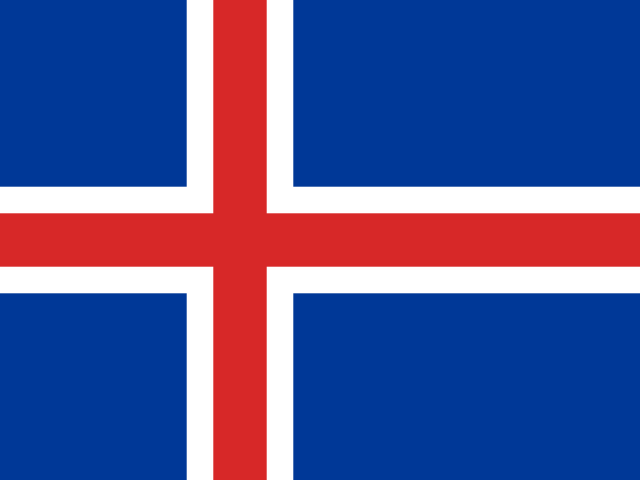
Iceland overview
Filed under Europe and more precisely Northern Europe, Iceland is a sovereign state. Its seat of government is Reykjavik.
The land area is 103,000 km², which ranks it 108th of the 249 countries and territories in this dataset — just behind Guatemala and just ahead of South Korea. That makes it almost exactly the same size as South Korea.
It is home to roughly 386,506 people, placing it 178th of 249 by population — between the Bahamas above it and Guadeloupe below. Measured only against its own subregion, it is 5th of 16 in size and 10th in population.
What lies nearest to Iceland
Iceland has no land border with any country, which changes what "nearby" means. Measured centre to centre in a straight line, the closest other entry on this site is Faroe Islands, roughly 640 km away. These are approximate distances between representative points, not the shortest crossing between two shorelines, so treat them as a sense of scale rather than a sailing chart.
Being surrounded by water rather than by neighbours pushes a country's relationships outward. Greenland sits in a different world region from Iceland yet ranks among its closest geographic company — the kind of pairing that only shows up once you stop thinking in continents.
No land border also means no land crossing: everything and everyone arrives by sea or by air. That single fact drives a lot of what follows on this page, from how goods reach the shops to why Iceland's dialling code and internet domain are worth knowing before you travel.
| Nearest entry | Region | Approx. distance |
|---|---|---|
| Faroe Islands | Europe | 640 km |
| Greenland | different region | 1,180 km |
| Isle of Man | Europe | 1,410 km |
| Norway | Europe | 1,420 km |
| Ireland | Europe | 1,450 km |
Geography and neighbours of Iceland
Its reference point sits at 65.0° north and 18.0° west, which puts it in the northern hemisphere, roughly 7,236 km from the equator, in what geographers would call high-latitude latitudes.
Countries on the same parallel, far away in longitude, include Finland.
It shares no land border with anyone. That puts it among the 85 entries of 249 here with no land neighbours, so everything and everyone arrives by sea or by air.
Where Iceland is on the map
The map below is centred on Iceland at roughly 65.00°, -18.00°. Pan and zoom to see how it sits against its surroundings — the shape of a country's borders explains a surprising amount about its history.
Map data © OpenStreetMap contributors
Iceland at a glance
- Capital
- Reykjavik
- Population
- 386,506
- Area
- 103,000 km²
- Region
- Northern Europe, Europe
- Languages
- Icelandic
- Currency
- Icelandic króna (ISK)
- Calling code
- +354
- Internet TLD
- .is
- People per km²
- 4
Who lives in Iceland
Population divided by land area gives roughly 3.8 people per square kilometre, which makes it very thinly populated. The median across all 249 entries here is about 91 per square kilometre.
People from Iceland are called Icelanders.
Officially it is monolingual: Icelandic. No other entry in this dataset lists Icelandic, so on this list it stands alone.
Against Europe as a whole it is the 41st most populous of 53 entries, and it accounts for under 1% of everyone living in Northern Europe.
How big is Iceland, really?
Put next to every other entry on this site, Iceland ranks 108th of 249 by area and 178th by population. That works out at 0.069% of the combined land area of all 249 entries and less than a thousandth of a percent of their combined population. Those denominators matter: this list includes territories and dependencies as well as UN member states, so a rank here is not the same as a rank among sovereign countries.
For a sense of scale, the entries immediately either side of Iceland in the size ordering are Guatemala at 108,889 km² and South Korea at 100,210 km², against Iceland's 103,000 km². If you can already picture one of those, you can picture this one.
Density tells a different story from either raw figure. Iceland averages 4 people per square kilometre of total area, which makes it among the emptiest places on the list — 235th of the 247 entries that have both a population and a measured area. Total area includes inland water, so the true figure for habitable land is higher than this.
Money and language in Iceland
The Icelandic króna (ISK) is used only in Iceland among the 249 entries on this site. Its own currency is one of the clearest markers of an economy that sets its own monetary policy rather than importing somebody else's.
Icelandic is listed for Iceland and for no other entry on this site. A language confined to one country is unusual, and it is normally a sign of long isolation or of deliberate revival.
The practical details for Iceland
Money there is the Icelandic króna (kr, ISK). No other entry in this dataset uses it, so the currency is specific to Iceland.
Websites there use the .is domain. Calls from overseas start with +354. Its ISO codes are is and ISL, which is what most databases and flag files use.
Reykjavik is the seat of government and the answer most quizzes are looking for.
As a sovereign state it is among the 192 UN members listed here. The other 57 entries are territories, dependencies or observers, which is why totals on this site run to 249 rather than the familiar 195.
Iceland within Northern Europe
Zoom in from the world to Northern Europe and Iceland sits 10th of 16 by population and 5th by area. Its immediate company in that ordering is Estonia just above and Jersey just below, which is a more honest comparison set than a global league table.
United Kingdom is the largest of the group by population, and every entry in Northern Europe has its own page here if you want to work through the whole neighbourhood rather than one country at a time.
Fun facts about Iceland
- It lies about 7,236 km from the equator, in high-latitude latitudes.
- Its capital city is Reykjavik.
- It is 178th of 249 by population, with about 386,506 residents.
- Icelandic is listed as an official language for no other entry in this dataset.
- People from Iceland are known as Icelanders.
- Finland sits at almost the same latitude, on the far side of the globe.
- The Icelandic króna is used here and nowhere else on this list.
- Websites based there use the .is domain.
Iceland — frequently asked questions
- What is the capital of Iceland?
- The capital of Iceland is Reykjavik.
- How big is Iceland?
- Iceland covers 103,000 km², ranking 108th of 249 by land area. That makes it almost exactly the same size as South Korea.
- What language is spoken in Iceland?
- The official language of Iceland is Icelandic. No other entry on this list gives it official status.
- What currency does Iceland use?
- Iceland uses the Icelandic króna, written kr (currency code ISK). No other entry in this dataset uses it.
- Where is Iceland located?
- Iceland is in Northern Europe, part of Europe. Its reference coordinates are 65.0° north and 18.0° west, roughly 7,236 km from the equator in high-latitude latitudes.
- Is Iceland a country?
- Yes. Iceland is a sovereign state and one of the 192 UN members listed on this site.
- What is the population of Iceland?
- Iceland has a population of about 386,506, which makes it the 178th most populous of the 249 countries and territories listed on this site. The Bahamas sits just above it and Guadeloupe just below.
- Does Iceland border any other country?
- No. Iceland has no land border with any other country, so every route in or out is by sea or air. 85 of the 249 entries on this site are in the same position.